
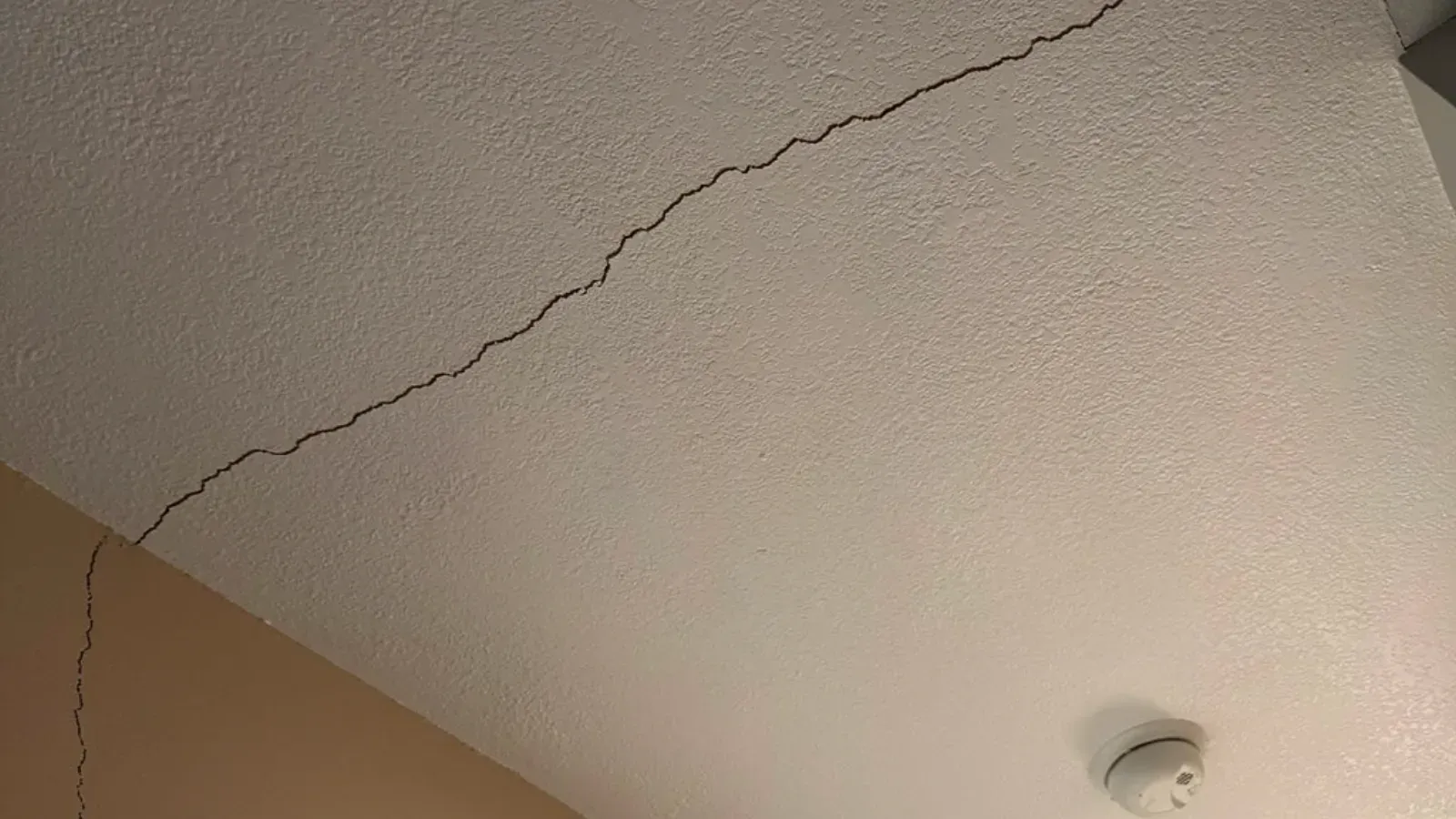
Signs you need this
- • A ceiling that bellies downward in the middle of the room, sometimes with a visible line where the plaster keys have pulled loose from the wood lath behind it.
- • An old brown or tan ring on a ceiling that is bone dry to the touch, with the paint over it cracked and curling, left over from a leak that was fixed a long time ago.
- • Hairline cracks fanning out from a ceiling light fixture or running along the seam where a prior drywall patch meets the original plaster.
New Bedford Drywall & Plaster repairs and rebuilds ceiling surfaces specifically, which behave differently than walls because gravity is working against every repair. That means re-keying or skimming a plaster ceiling in a historic County Street home, cutting and patching a settled drywall ceiling section, or rebuilding a stairwell ceiling in a three-story North End triple-decker where access and height drive the work as much as the material does. The crew matches the existing texture on the plane overhead, whether that is a smooth Level 5 skim or a knockdown pattern, so the repair disappears from below rather than reading as a patch.
This service is for owners of North End triple-deckers along the Acushnet Ave corridor with keyed lath-and-plaster ceilings pulling loose after decades of thermal cycling and aging fasteners, and for landlords managing rental turnover in that same dense North End housing stock who need a ceiling stabilized and blended quickly between tenants. It is for owners of pre-1900 homes in the County Street historic district and near the downtown Whaling National Historical Park who want an original plaster ceiling preserved with a skim coat instead of demolished to drywall, and for homeowners citywide with an old, fully dried water stain on a ceiling from a leak that was resolved months or years ago, who want it sealed, repaired, and repainted, not confused with an active leak.
Materials & standards
Products & materials we use
- USG Sheetrock
- National Gypsum Gold Bond
- CertainTeed
Standards & codes we work to
- Massachusetts State Building Code (780 CMR)
- ASTM C1396
- GA-214 finish levels (Level 4/5)
- EPA RRP (pre-1978 lead-safe)
What the terms mean
- keyed plaster
- plaster washers
- skim coat
- lath-and-plaster
- texture matching
- knockdown texture
- orange-peel texture
- popcorn removal with asbestos-age testing
- Level 5 finish
Options & variants
| Option | When it applies | Cost |
|---|---|---|
| Keyed plaster ceiling stabilization | Original lath-and-plaster ceiling sagging with broken or cracked keys, structure otherwise sound | Moderate; plaster washers re-anchor the plane, then skim over |
| Historic-sensitive skim coat | Owner wants the original plaster ceiling preserved rather than replaced | Moderate to higher; slower, hand-finished work over lath |
| Cut-and-patch drywall ceiling | Localized settling crack or old dried water stain on a drywall ceiling | Lower to moderate; targeted section, blend to surrounding texture |
| Full ceiling replacement | Widespread cracking, sagging, or aged popcorn texture across the whole plane | Higher; more board or plaster, texture matching across the full ceiling |
What affects cost
- • Height and access: a stairwell or cathedral ceiling in a North End triple-decker takes longer to scaffold and work overhead than a standard first-floor room.
- • Plaster versus drywall: re-keying and skimming original lath is slower, hand-finished work compared with cutting and hanging a new drywall section.
- • Texture matching: blending into an existing knockdown, orange-peel, or smooth Level 5 ceiling adds a step a flat patch doesn't need.
- • Lead-safe practice under EPA RRP applies whenever old paint on a pre-1978 ceiling gets disturbed, which is most of New Bedford's older housing stock, and that adds containment and cleanup time.
- • Whether old popcorn texture is present, since it needs asbestos-age testing before removal on houses built before the material was phased out.
What to expect
- 1
Inspect the ceiling plane
New Bedford Drywall & Plaster inspects the ceiling plane, identifies whether it's plaster or drywall, checks for broken keys or settling cracks, and confirms there's no active moisture behind the surface.
- 2
Protect and contain
Floors, furniture, and fixtures below are protected and the work area is contained before any cutting or drilling starts.
- 3
Re-anchor or cut back
Loose plaster keys are re-anchored with plaster washers, or a failed drywall section is cut back to a sound, straight edge.
- 4
Rebuild the plane
The ceiling plane is rebuilt: a skim coat over stabilized plaster, or new board hung and taped where drywall was cut out.
- 5
Texture-match the finish
The repair is finished and textured to match the surrounding ceiling, whether that's a smooth skim, knockdown, or orange-peel pattern.
- 6
Clean up and walk through
The area is cleaned up and walked through with the owner before the crew leaves.
When this isn’t the right call
- If the stain is still soft or spreading and the ceiling feels damp to the touch, that's active water damage, not a dried-stain repair, and it needs the water damage drywall repair service instead.
- If the damage is a single small hole or a scuff on a wall rather than the ceiling plane, that's everyday drywall repair patching.
- If a crack keeps returning in the same spot after being patched before, tracing to a joint or movement problem, that's better handled as drywall crack repair, which chases the underlying cause instead of just the ceiling surface.
Frequently asked questions
My plaster ceiling is sagging but I want to keep it, not switch to drywall. Is that possible? +
Often, yes. New Bedford Drywall & Plaster checks whether the lath and framing behind the plaster are still sound. If they are, the crew re-anchors the loose keys with plaster washers and skims over them, which keeps the original ceiling instead of tearing it out.
How do you match the texture on an old ceiling? +
The crew tests the existing pattern, whether it's a smooth skim, a knockdown, or an orange-peel spray, and works the new material to match before it dries, so the repair doesn't read as a different plane from below.
Is a sagging ceiling dangerous? +
A ceiling with broken plaster keys has already lost part of its grip on the lath. It's not usually an emergency, but it will not fix itself, and a section that sags further can eventually come loose.
I have an old water stain on my ceiling but the leak was fixed years ago. Do I still need a moisture check? +
Yes. New Bedford Drywall & Plaster confirms the board or plaster is fully dry before sealing and refinishing, since a stain that looks old can still hide a slow, ongoing source.
Do you test for asbestos before removing popcorn texture? +
On any ceiling old enough to plausibly carry it, yes. Testing happens before removal, not after.
Why does ceiling work cost more than wall work for the same size area? +
Height and access. Working overhead from a ladder or scaffold, especially in a stairwell, takes longer than the same repair on a wall at arm's reach.