
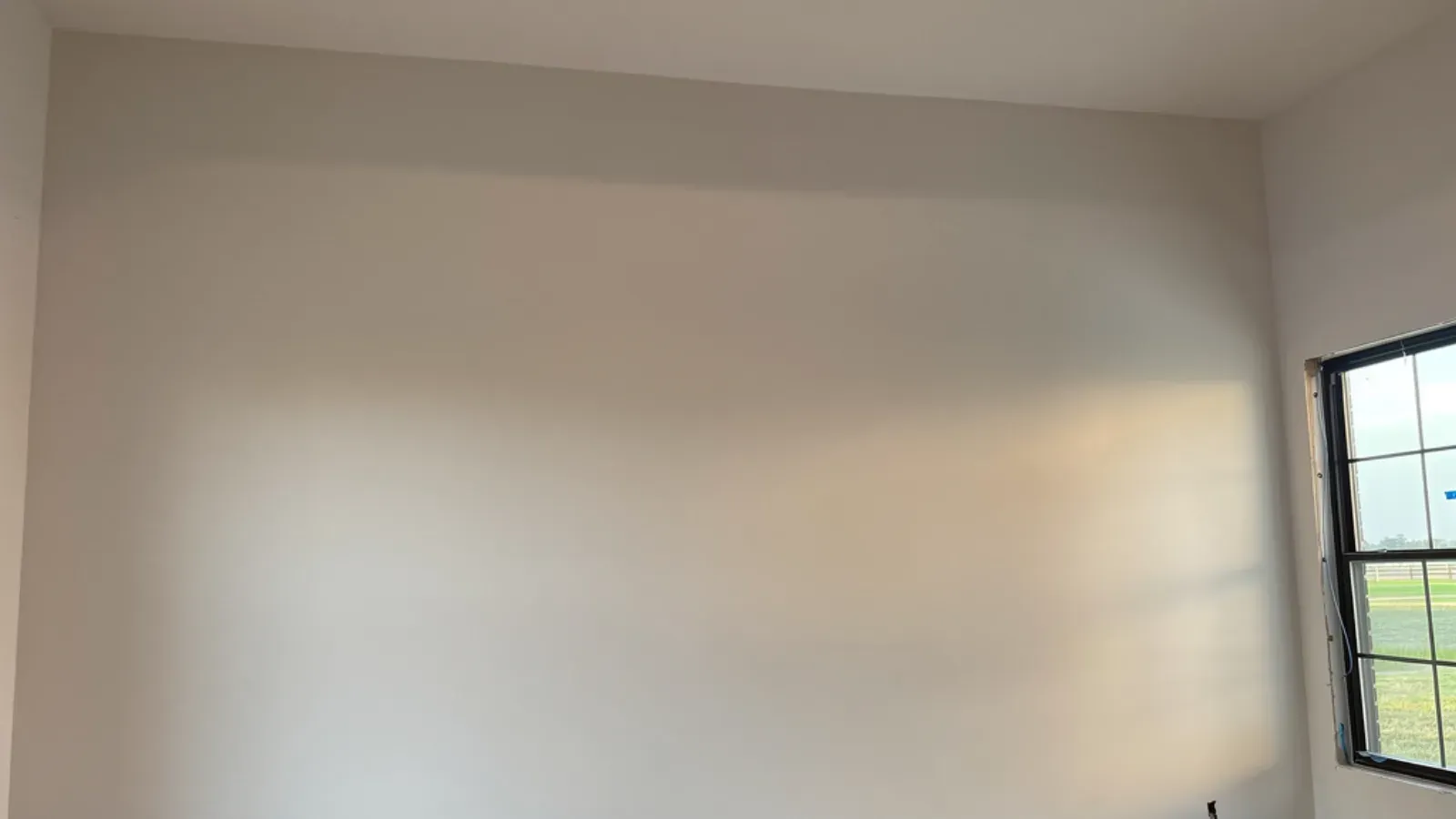
Signs you need this
- • Joint lines and screw pops that show through paint the moment side light or a window catches the wall at an angle.
- • A wall or ceiling that looks faintly wavy or patchy once a satin or gloss paint goes on, even though flat paint used to hide it fine.
- • Years of small touch-up patches leaving a mottled surface, some spots flatter than others, that never reads as one continuous plane.
New Bedford Drywall & Plaster resurfaces an entire wall or ceiling to a GA-214 Level 5 finish. A thin skim coat of joint compound goes over the whole surface, not just the damaged spots, then gets sanded and skimmed again until the plane is dead flat under raking light. This is resurfacing, not patching: every square foot of the wall gets coated and feathered so old seams, prior repairs, and minor texture variation disappear into one continuous, paint-ready surface. It’s the finish level a room needs before gloss or satin paint, backlit surfaces, or accent lighting, conditions where anything less than truly flat telegraphs through the sheen.
This service is for owners of South End homes near Clarks Cove and Fort Taber doing a full repaint who want a genuinely flat wall rather than another coat over old imperfections. It is for buyers and renovators of condo conversions along the Route 18 waterfront corridor, where developers spec dead-flat walls under gloss or eggshell paint and pot lighting. It also fits owners of older triple-deckers with decades of patch-over-patch history, multiple sheens and ridges built up from years of small repairs, who want one clean resurfaced plane instead of another spot fix, and design-conscious renovators who specifically ask for a Level 5 or smooth wall finish as part of a remodel.
Materials & standards
Products & materials we use
- USG Sheetrock joint compound
- National Gypsum Gold Bond
- Georgia-Pacific ToughRock
- FibaTape
Standards & codes we work to
- GA-214 finish levels (Level 0-5)
- ASTM C1396
- Massachusetts State Building Code (780 CMR)
What the terms mean
- skim coat
- Level 5 finish
- feather/blend
- raking light
- wall resurfacing
- priming for finish
Options & variants
| Option | When it applies | Cost |
|---|---|---|
| Level 4 standard skim | Rooms going to flat or matte paint, where most seams just need to disappear | Lower; single skim and sand pass |
| Level 5 full skim | Gloss or satin paint, accent lighting, or open sightlines where flaws show | Higher; full-surface skim plus a final skim and prime coat |
| Ceiling-only Level 5 | Ceilings under can lighting or skylights where the walls matter less | Moderate; priced to ceiling square footage |
| Whole-room resurfacing over patch history | Rooms with years of mismatched prior repairs and sheens | Higher; more prep needed before the skim coat can go on evenly |
What affects cost
- • Total wall and ceiling square footage being resurfaced, since Level 5 work is priced by area, not by repair count.
- • How much prior patch history, mismatched sheens, or texture variation is already on the wall, since an inconsistent old surface needs more prep before the skim coat can go on evenly.
- • Ceiling height and how much furniture and flooring need protecting, since staging for a full-room skim takes more setup than a single accent wall.
- • Whether the finish paint is gloss or satin versus flat, since a higher-sheen paint calls for a truer Level 5 while a flatter paint would still forgive a Level 4.
- • The number of corners, windows, and trim transitions that need hand-feathering, since more edges mean more finishing time.
What to expect
- 1
Inspect under raking light
New Bedford Drywall & Plaster walks the room under strong side lighting to find every seam, old patch, and high spot before any compound goes on.
- 2
Protect and contain
Furniture and flooring are protected and the space is contained, since a full skim coat means dust across the whole wall, not just a repair zone.
- 3
Apply the base skim coat
A base skim coat is applied across the entire surface, feathering old repairs and seams into the field rather than treating them as separate spots.
- 4
Sand and second skim
The compound is sanded, then a second skim coat closes the pinholes and sanding marks the first pass revealed.
- 5
Final sand and check
A final sand and a raking-light check confirm the plane is flat before anyone calls it finished.
- 6
Prime and walk through
The surface is primed for a uniform base, and the room is cleaned and walked through with the owner.
When this isn’t the right call
- If only one or two small areas are damaged, a hole, a crack, or a water stain, that is a standard drywall patch repair. Resurfacing an entire wall for one flaw costs more than the problem calls for.
- If the walls carry knockdown or orange-peel texture the owner wants to keep, matching that pattern into a repaired spot is drywall texture matching, the opposite goal of a smooth skim finish.
- If a ceiling has sprayed popcorn texture, that has to be dealt with as popcorn ceiling removal first, including asbestos-age testing on older houses, before any skim coat can go over it.
Frequently asked questions
What is a Level 5 finish, and do I actually need it? +
Level 5 is the flattest finish level in the GA-214 standard, a full skim coat over the whole surface rather than just the seams. Most rooms are fine at Level 4; Level 5 matters when the paint is gloss or satin, or when angled light and accent fixtures would otherwise show every seam.
My walls look fine in normal light. Why would I pay for this? +
Flat paint hides a lot. The moment a wall goes to a higher sheen, or gets raking light from a window or a can light, seams and old patches that were invisible before start showing. This is prep work done ahead of that problem, not a fix after the fact.
Can you skim coat over old plaster, not just drywall? +
Yes. Sound plaster takes a skim coat the same way drywall does, as long as the surface underneath is structurally solid. Plaster that's failing needs to be addressed first.
How long does a full room take? +
It depends on square footage and how much prior patch history is on the walls, but plan for multiple coats with drying and sanding time between each, not a single-day job.
Will this fix the cracks and holes that are already there? +
Yes, existing damage gets repaired as part of the process, then the whole surface is skimmed over it so the repair blends into the resurfaced plane rather than standing out as its own patch.
Do I need to repaint after this is done? +
Yes. A skim coat is not a finished surface, it's a smooth, primed base built for whatever paint sheen comes next.